
Paper’s are everywhere, and they’re flying all over the place

The October edition of the Economist published an article in 2013 calling out the scientific community and the validity of thier findings. (http://www.economist.com/news/briefing/21588057-scientists-think-science-self-correcting-alarming-degree-it-not-trouble) While the amount of scientific papers released has been rising over the past years, the amount of results that are actually reproduced with success is markedly smaller. This inconsistency is seen in many areas of science, from preclinical cancer studies to neuroscience and psychology. In addition, more papers are getting past the peer-review despite having procedural inaccuracies, improper use of statistics or poor study control.
The article examines several causes for this decline in scientific publishing. The poor reproducibility could be due to : procedural mistakes by the original or the reproducing group, errors in data analysis and reporting from either group and tacit knowledge of the original experimenter about his procedure (Only the experimenter can truly reproduce his experiment as it may involve very subtle manipulations that are difficult to communicate by text) . Another issue is that there are more and more papers published that are innacurate in one way or another. The author believes this occurs because of pressure on scientists to publish, lax peer-review standards (Although journals are working to improve now), and incorrect use of statistics or data fitting models. The peer-review process was called out in an experiment highlighted in the article, where a fake paper produced by a made up harvard prof was sent to 300 journals for peer review and ended up being published in half of them! The article calls into question today’s academic atmosphere that stresses mass production of papers just to maintain funding and motions for a value shift that encourages publishing quality work regardless of whether it is successful or not. Such a shift, the author believes will promote a healthier culture for researchers to make contributions to one another’s work.
I found this article to be very eye-opening for me as someone who may pursue a career in science, of mistakes that occur in the field. I feel it’s always important to know what can go wrong so that I can be careful in those situations and take steps to ensure that things occur smoothly without any mistakes. For a field as big as science, it is very difficult for a professional organization or college to police each individual researcher and it is often upon the individual to make sure that he/she is on the right track. A great way to stay on the right track is by understanding where mistakes are commonly made, and why they are made which this article does a good job highlighting. I also gained some awareness of the climate today’s researchers are in with ever-thinning budgets, a heavy pressure to publish and the effects of it all. It definitely has me thinking about ways I can try to make changes to improve the scientific atmosphere.
What do you think about this article? Have you read any papers that left your head scratching? What solutions do you have to improve the scientific atmosphere?
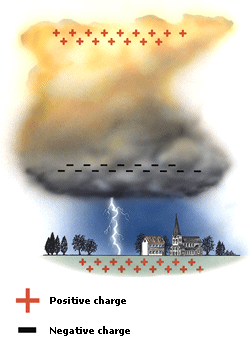
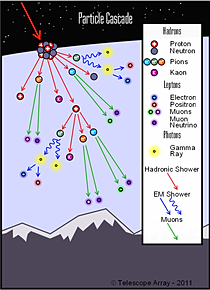
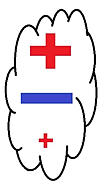 When these air showers are taking place near a thundercloud, the trajectory of the charged secondary particles is adjusted because of the strong electric fields in the thundercloud. As a result, the direction and polarization of the resultant radio wave is altered. The Dutch researchers were able to model this effect mathematically, allowing them to make inferences on the electrical nature of a thundercloud by taking measurements of the radio waves emitted from cosmic radiation in the presence of a thundercloud. The scientists showed that the charge in a cloud is structured in such that a dense middle layer of negative charge is sandwiched between a sparse lower layer and a dense upper layer of positive charge. This arrangement of charge has been theorized for quite some time with evidence such as from these measurements lending support to the hypothesis.
 shankarpro1
